
How this proptech startup is disrupting the real estate market with draws and flash sales

How this proptech startup is disrupting the real estate market with draws and flash sales
During an online sales season that was sending many on a shopping spree several years ago, Swapna More asked her driver what was on his shopping list.
The driver’s response became the genesis for her latest venture KAGAAY. He told her, “I wish I could grab a house at the best price, just like the sales going on Amazon and platforms. It would be great if I can get a home at the best price the way I bought my mobile.”
Swapna was intrigued by how he commoditised houses while for most people, buying a home was an emotional process, entailing many site visits, opinion gathering, location sieving, and more.
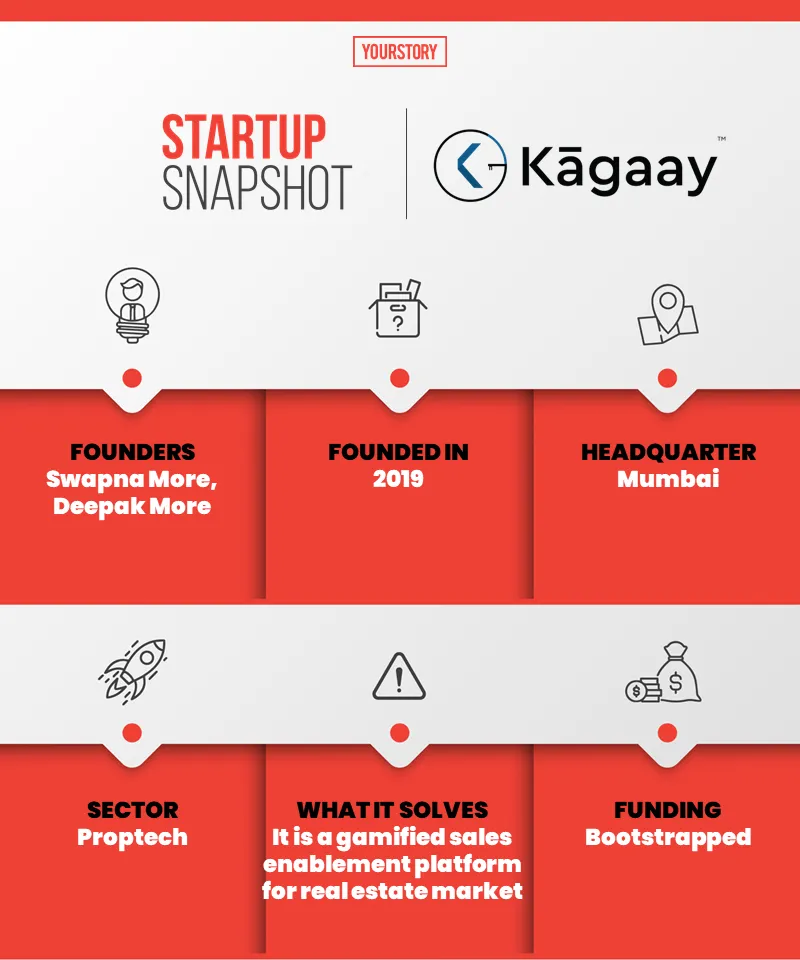
In 2019, she started KAGAAY, a gamified sales enablement platform to deliver the right price asset advantage to buyers and investors and fast track asset liquidation for realtors and bankers.
The team behind the idea
Swapna ventured into the real estate sector with her husband in 2011. After working with several developers to market their real estate products, she felt uncomfortable with them not delivering on their promises and started Commander Estate Developers LLP in 2016.
A serial entrepreneur, she has also dabbled in the restaurant business by co-founding Aghamarshana Hospitality LLP and Tapariwaala café in Navi Mumbai and Ambernath.
Co-founded with her husband, Wing Commander Deepak More, the duo was joined by Tushar Desai as Chief Technical Officer and several veterans from real estate industry.
Tushar brings with him over two decade’s experience in the IT industry and leverages artificial intelligence and machine learning tech for KAGAAY.
How does KAGAAY work?
A mobile application-based product, realtors can onboard their properties, offer exclusive discounted prices, and participate in various games like Draw of Lots and Flash Sales to attract buyers and generate faster sales. Realtors must subscribe to the startup’s membership programme.
The proptech startup mandates that only realtors or agencies having exclusive rights to sell the units post on the platform.
For buyers, the platform offers virtual tours of properties including bird’s eye view, 3D walk through, 2D Plans, GPS location and information on the neighbourhood for residential, commercial, or just the plot of land.
If interested in a property, an Earnest Money Deposit (EMD) of about four to five percent of offered value on a property should be paid to block the unit. Within a month, buyers can complete an agreement with the respective realtors. KAGAAY charges success fees to realtors on every sale closed.
Swapna says the gamified aspect is helpful in dealing with sluggish sales cycles that plagues the real estate market today.
“Anything which is sluggish needs motivation, reward, and recognition. Today, customers are showing interest, conducting numerous site visits online, and negotiating for the “right” price on our platform,” she explains.
She further states that gamification helps “engage people meaningfully with interactions that would otherwise be considered bland,” according to Dr Lennart Nacke, Director of HCI Games Group at the University of Waterloo’s Games Institute in Canada.
In the game, Draw of Lots, there are a limited set of properties at exclusive discounted price for one month where buyers can try their luck. Winners who secure the properties can further participate in Bumper Draw to avail more discounts upon winning.
Games like Flash Sale running for 12 to 36 hours plays on the audience’s fear of missing out to grab exclusive deals on the platform.
Navigating real estate market
KAGAAY’s concept was initially met with doubt from most people in the real estate industry. But their first draw on December 25 last year spoke volumes where buyers exceeded the 196 flats offered on special price starting from Rs 17,17,000 by three times.
According to Swapna, they saw 521 registrations on the platform, 421 applications for the draw, and collected Rs 21 lakh. The event generated a business of Rs 49 crore from the sale of 196 flats within a month.
Started with an initial investment of Rs 2 crore, KAGAAY plans on launching a revamped version in 2021 and break even soon. They are now burning cash for marketing and human resources.
“There are many discovery platforms in the market, making information available to buyers on digital platforms. However, KAGAAY offers the opportunity to negotiate with realtor and make them quote the ‘right’ price,” says Swapna who is also the state chairperson for Maharashtra’s Confederation of Indian Micro, Small and Medium Enterprises.
Conducting real estate business on digital platforms has become important as movements are restricted in times of COVID-19.
The startup claims to be in talks with various government agencies to achieve 100 percent automation in real estate purchase and registration processes. With more than 10,000 inventories on board, it is now gearing up for a mega flash sale and a draw of lots in January 2021.
Published at Mon, 30 Nov 2020 00:33:45 +0000
The tech allowing thousands of students to sit exams at home

Getty Images
The phones began ringing off the hook at Piero Tintori’s company Better Examinations back in April.
His tech business allows tens of thousands of students to remotely sit exams at the same time, with each needing just a laptop, a webcam and an internet connection.
The firm’s software uses machine learning (ML), an advanced form of artificial intelligence, to detect patterns in user behaviour that could indicate attempts to cheat. Its technology can also automatically mark multiple-choice answers and mathematics exams.
In addition, it checks each exam-sitter’s identity using the webcam, to ensure that no-one else is sitting the test for them. The Better Examinations program also temporarily restricts access to the internet, or certain websites and applications on each person’s computer.
“We had 60 organisations from all over the world contact us out of the blue, who wanted to run exams online in May and June,” says Mr Tintori. “Everything from universities, to professional organisations, to schools.”

With the firm’s headquarters in Dublin, plus offices in the US, Australia and Poland, it uses Amazon’s cloud computing system Amazon Web Services, to allow everything to work online.
Mr Tintori says he was also contacted directly by five governments (whom he declines to name), who were keen for school exams to go ahead.
Better Examinations is just one example of the increased use of ML in response to this year’s pandemic, with the technology being used to do work far more quickly than humans, such as marking exam papers.
But what exactly is ML? It is a method of data analysis, whereby computer algorithms are used to speedily process vast amounts of data, to make predictions, identify patterns and replicate actions that humans do in their day-to-day jobs.
The use of ML is expected to grow so much over the next four years that its estimated global economic value is expected to rise from $7.3bn (£5.7bn) this year, to $30.6bn in 2024, according to one study.

Global law firm DWF, which helps the in-house legal teams of large corporations, is another business now increasingly using the technology.
It was approached by a large real estate company that had an “impossible” task. The client wanted 10,000 property lease documents, stored on paper and electronically, and in different locations, to be digitalised into a central database.
This firm also wanted to know the exact terms of each of the leases, to discover new commercial opportunities.
“Traditionally, you would get paralegals under supervision to plough through the documents. But from a cost point of view it doesn’t work, and also it’s inconsistent,” says Mark Qualter, chief executive of DWF’s managed services division.
DWF designed an ML system to classify each lease document into categories, identify specific types of details, and then extract data from the document.

The banking sector is also embracing ML. UK building society Nationwide had asked US computer giant IBM to build an artificial intelligence “chatbot” called Arti for it, to help first-time buyers understand how to get a mortgage.
But when the UK went into its first lockdown in March, and mortgage holidays were announced, the lender was instead inundated with queries about them.
In just four days, Arti – powered by AI platform IBM Watson – was retrained to answer mortgage holiday questions. The virtual agent also dealt with other questions as Nationwide saw online banking registrations jump by 89%.
“In just over two months, Arti had responded to more than 10,000 queries, and a further 350 per day since, freeing up hundreds of hours for frontline teams to focus their time handling more complex requests from members,” says Michael Conway, UK lead for artificial intelligence at IBM Services.
“Put simply, it allowed Nationwide to focus its resources on those who needed the most help, without ignoring the needs of everyone else.”

Meanwhile, another UK retail bank has been using ML algorithms to identify customers who are showing indications of financial difficulty, so that they can be contacted automatically, and then offered support before matters get out of hand.
This has been provided to the lender by BJSS, a multinational technology engineering consultancy headquartered in Leeds.
Sri Harsha Tharkabhushanam, head of data science for BJSS, says that previously of those in arrears, 30% had got to a severe position where “there was very little the bank could do for them at that point”.
But after implementing the ML model, the automated prompts meant fewer people were getting into severe difficulties, with the figure falling to 10%.
Business intelligence gathering using AI is also becoming a big deal.
For instance, a large European pharmaceutical firm, which wants to remain anonymous, wanted to make sure that if there was a new product launched, or start-up bought, by any of their competitors, it knew about it quickly.


New Tech Economy is a series exploring how technological innovation is set to shape the new emerging economic landscape.
The company employed Filament AI, a machine-learning software firm in London, to build it a bespoke ML system that could monitor 1,000 websites, 200 story feeds, and roughly 200,000 news articles a day round the clock.
Michael Osborne, a professor of machine learning at Oxford University, says that companies across many industries are now “desperately trying to get their hands on ML”, as many more things are now being quantified digitally, making it easier to analyse them to gain insights.
Martha White, associate professor of computing science at the University of Alberta in Canada, agrees that the use of ML is growing fast.
“The combination of more data, and more powerful computers, and a focus on leveraging both has really propelled the field forward,” she says.
“The prevalence will continue to grow for a few reasons. Firstly, there is still lots of low-hanging fruit, and the ability to monetise with the existing technology. Secondly, we are going to get better at improving our own decision making, using predictions from machine-learning systems.”
But although ML is becoming increasingly popular, there are concerns it has been oversold as a “magic wand”, and the public’s distrust of it is only rising, warns Prof Osborne.
“ML is not this all-singing, all-dancing solution to our woes,” he says. “Instead it’s something that delivers value only when working hand-in-hand with humans, and having humans tailor it to their specific needs.
“ML is powerful, but not a fully general-purpose technology. It needs a lot of careful tweaking to get it to work for any new application.”
Published at Mon, 30 Nov 2020 00:00:00 +0000


